
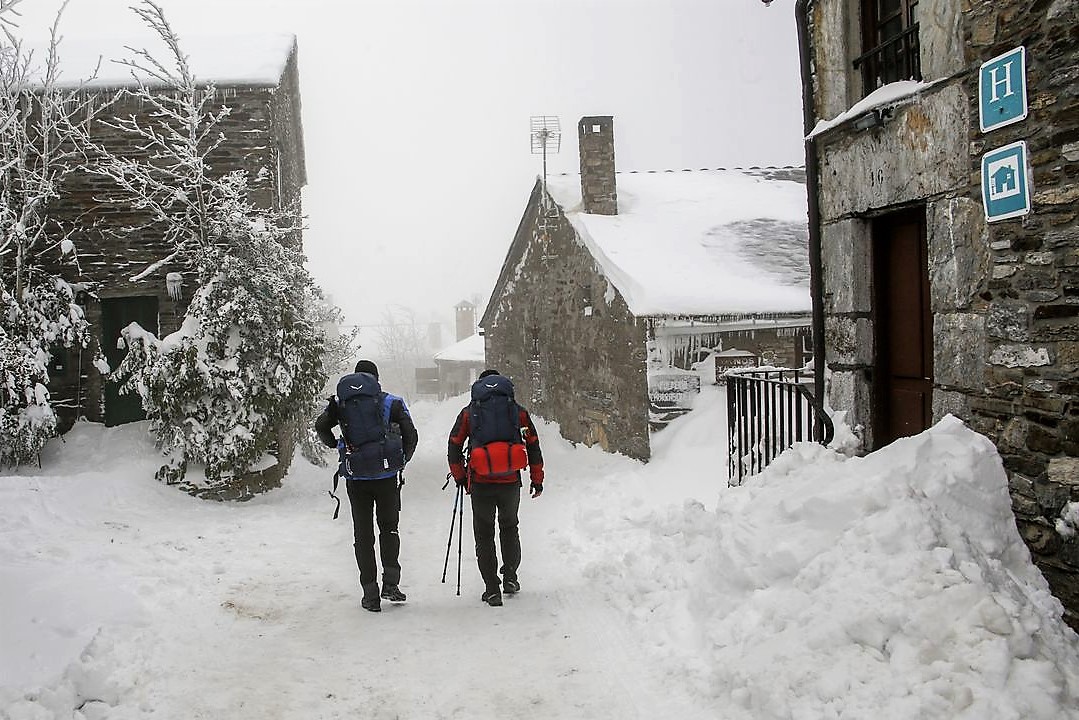
Most pilgrims walk in May or September, when the days are long and every albergue door along the way stands open. A smaller number walk in winter — and many of them will tell you, quietly, that they would not trade their winter Camino for any other.
Winter changes the terms of the walk. That is the first thing to understand, and for the right pilgrim it is not a warning. It is the invitation.
The quiet road
In summer the Francés can feel like a procession: a steady current of walkers, full cafés, a race for beds by early afternoon. In winter the current slows to a trickle. You may walk a whole morning stage and meet a handful of people. The ones you do meet, you meet properly — there are so few of you that every encounter becomes a conversation, and the small company of winter pilgrims who gather around an albergue stove in the evening has a warmth the crowded season rarely matches.
The land shows a different face, too. Frost on the meseta at first light. Snow on the Montes de León and, sometimes, on the climb to O Cebreiro. Bare vines in La Rioja, woodsmoke over Galician villages, storks gone and the bells sounding all the clearer for the empty air. The Camino’s old churches and monasteries were built for centuries in which most travel was slow and most of it was cold; in winter, the road feels closer to the one the first pilgrims knew.
What winter asks of you
Honesty matters here, because winter is not simply the summer Camino with a coat on.
The days are short. In December and January you have perhaps nine hours of light, and the rhythm of the walk changes with them: earlier starts are pointless in the dark and the cold, stages run shorter, and there is a particular pleasure in arriving while there is still afternoon left for washing, resting and a hot meal. Distances that feel easy in June deserve more respect in January.
The cold is real but manageable, and it is rarely the hardest part. Wind on the open meseta and rain in Galicia test a pilgrim more than low temperatures do. Good layers, genuinely waterproof boots and a warm sleeping bag matter more than any single expensive garment. Snow can close the high passes for a day or two at a time — the Napoleon route over the Pyrenees is not a winter route, and the Valcarlos valley is the way through — and the wise winter pilgrim builds in spare days and treats a weather-enforced rest as part of the pilgrimage rather than an interruption of it.
And some of the infrastructure of the summer Camino simply goes home. Village bars keep shorter hours or close entirely. A fountain you remember from a spring walk may be the only company at a crossroads where, in August, there was a food truck. Winter walking rewards a pilgrim who plans the day in the morning — where to eat, where to stop — instead of assuming the road will provide at every hour.
Where winter pilgrims walk
Winter walkers are found on several routes, but the great majority are on the Camino Francés. It carries roughly half of all pilgrims across the year and an even larger share in the cold months, because it has the deepest network of villages, services and beds to draw on when so much else has closed. The Portugués sees a gentle winter trickle, milder in weather but thinner in open accommodation. For most first-time winter pilgrims, the Francés is the sound choice — and for those who cannot give a winter month to the road, its last hundred kilometres, from Sarria to Santiago can be walked in five or six days and make a complete winter pilgrimage in miniature: quiet Galician lanes, eucalyptus and chestnut woods, and a Compostela earned in the season when Santiago itself is at its most beautiful and least crowded.
The real question: where will you sleep?
Ask a returning winter pilgrim what actually required planning, and the answer is rarely the weather. It is beds.
From November to February, a large share of albergues on the Francés close for the season — owners rest, buildings are repaired, and villages that host hundreds of pilgrims a night in summer may have a single open door, or none. A bed cannot be assumed from one stage to the next the way it can in May. The winter pilgrim’s essential discipline is simple: know, before you set out in the morning, where you will sleep that night — and ideally the night after.
That is why we keep a list. Working from the winter list published each year by APRINCA, the association of winter albergue hosts, we maintain a stage-by-stage record of the albergues open in winter on the Camino Francés — 86 albergues for the winter of 2026–27, with their closure dates and booking rules noted on each property’s page as well. It is the single piece of planning a winter walk cannot do without, and it exists because the hospitaleros who stay open through the cold months deserve pilgrims who arrive prepared rather than surprised.
A few working rules, learned from the list and the road:
- Book or phone ahead in winter, even if you never would in summer. Many winter albergues open for whoever has called; some keep a door closed on days when nobody is expected.
- Respect the closure dates. Several albergues close for a week or two around Christmas and New Year, or for set days each week — the list notes them, stage by stage.
- Carry the next option, not just the plan. If your intended albergue is full, closed or simply dark, knowing the following village’s open bed before you leave in the morning turns a crisis into a longer walk.
- Shorten the stage, lengthen the welcome. Winter pilgrims are few, and hospitaleros remember them. Arriving unhurried, in daylight, is both safer and better manners.
Is winter for you?
Winter is not the Camino with the difficulties removed; it is the Camino with the distractions removed. There is less choice, less noise, less company — and, many winter pilgrims find, more of the thing they came for. If you are drawn to the road as an inward journey as much as an outward one, if you can plan a bed ahead and dress for honest weather, and if the thought of a near-empty trail under a low winter sun sounds less like a hardship than like a gift, then the quiet season may be your season.
The beds are there. Fewer of them, warmer for being chosen. You only have to know where they are before you set out.
Winter albergues: the direct answers
Which albergues are open during the winter on the Camino de Santiago?
There is no single year-round network — from November to February many albergues close, and the ones that stay open are concentrated on the Camino Francés, where most winter pilgrims walk. For winter 2026–27, 86 albergues on the Francés are listed as open, stage by stage, in our albergues open in winter on the Camino Francés list, drawn from APRINCA, the association of winter albergue hosts. On other routes, notably the Portugués, far fewer beds stay open, so check and phone ahead for every night rather than assuming a bed in the next village.
How do I find a bed in winter?
Know before you set out in the morning where you will sleep that night — and ideally the night after. Book or phone ahead even if you never would in summer, respect the closure dates noted for each albergue (several close for a week or two around Christmas and New Year), and carry the next village’s open option as your fallback.
Buen Camino — in every season.