
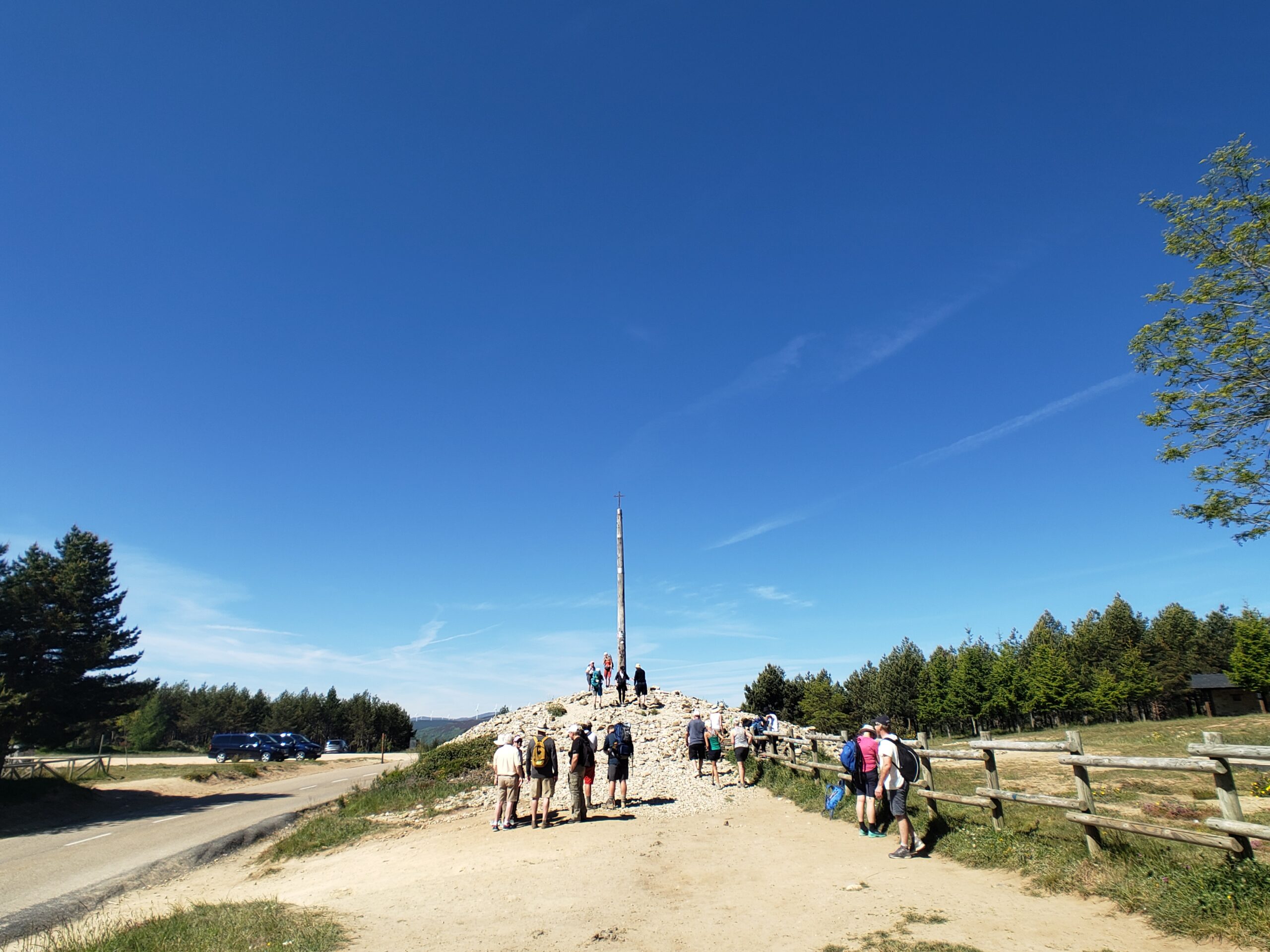
If you’re walking the Camino Francés this month, you may have seen a worrying post making the rounds: that the Cruz de Ferro is “closed” for two weeks. The works are real — but the Camino is not closed, and there is no detour. Here is what is actually happening.
The mound of stones beneath the cross — built up, stone by stone, by generations of pilgrims — is being restored. Over the years, stones have been pulled out of the mound and rearranged into patterns and figures, objects that were never stones have been left behind, and vehicles driving too close have damaged the ground. So the mound is being put back to its traditional shape, the way it appears in old photographs: the existing stones redistributed by hand, the ground beneath consolidated and drained, and everything that isn’t a pilgrim’s stone removed.
Around the mound, a low wooden enclosure will mark its edge, vehicles will be kept away and the nearest parking removed, and the ground replanted with native species — heather, rockrose, broom. An accessible path to the base of the mound and an interpretive panel are part of the project too. The work is promoted by the Camino Francés Federation together with the Friends of the Camino associations of Astorga and the Bierzo, funded by the Junta de Castilla y León, and carried out through the Ayuntamiento de Santa Colomba de Somoza. It began in mid-October. The design itself was chosen earlier this year by public vote, from several proposals shared on social media — the winning one took 80% of the vote. You can watch the Federation’s presentation video of the winning proposal here.
What does this mean if you’re on the trail now? You can walk past as always — the route stays open throughout. But direct access to the cross itself may be interrupted while the work is underway, for up to two weeks at most. So there may be days when you can see the cross and the mound, yet not climb to leave your stone. No day-by-day schedule has been published, so if you are a day or two out, ask in Rabanal or Foncebadón what the situation is that morning.
The stone you carry to the Cruz de Ferro matters — pilgrims have carried them from home, sometimes for hundreds of kilometres, as a burden set down at last. If you arrive on a day when the mound is being worked on, hold on to it a little longer rather than leaving it somewhere it doesn’t belong. The mound has waited centuries. It will be there, in its old shape again, when you reach it.
(Sources: Heraldo de León, 13 October 2026; Federación Española de Asociaciones de Amigos del Camino de Santiago, 15 October 2026.)