 Pamplona is the first major city the pilgrim reaches after de
 scending from the Pyrenees. It is also the largest city along the Camino Francés and the historic capital of the ancient kingdom of Navarra. Over 90% of the wine production of Navarra is red. The main grape variety is tempranillo, but other types such as garnacha and cabernet sauvignon are prominent. Among the whites are chardonnay, malvasia and viura.
After passing over the Alto de Perdon, you enter the first of the sub-regions of wine making, the Valdizarbe, where the main centre of production is Puente La Reina, the stopping point of Stage 4. In addition, you can see the vineyards as you pass through the villages of Legarda and Muruzábal approaching Puente la Reina.
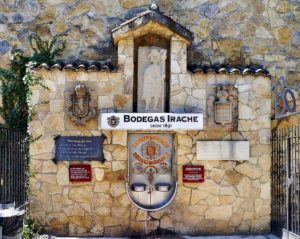
Continuing your journey westward along the Camino brings you to Estella, the stopping point for Stage 5. This is the centre of the next sub-region in Navarra, Tierra Estella. The main grapes you will see are mostly the red tempranillo and cabernet sauvignon. You will pass among the vineyards walking through the villages of Mañeru, Cirauqui, Villatuerta and into Estella. As you make your way to Los Arcos (stopping point Stage 6) you will see the vines in Ayegui, Irache, Villamayor de Monjardín, and Luquin. The long flat road out of Los Arcos passes through Sansol and Torres del Río before reaching Viana and the end of the D.O. Navarra. Remember to fill your cup at the free wine fountain of Bodegas Irache outside of Estella.
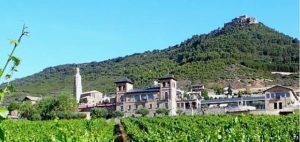
Top photo – Castillo Monjardín winery in Villamayor de Monjardín (stage 6 towards Los Arcos)
Bottom photo – Free wine fountain at Bodegas Irache (outside Estella stage 6)
Next.. Txakoli, the effervescent (and hard to pronounce) white wine of the Basque country.


 There will be lots of opportunities on the camino to experience the special tastes of the Spanish kitchen. Some of those flavors are uniquely regional and can only be sampled “at the source”. This is certainly true of the wine “Txakoli (chack-oh-lee) or Chacolí in Spanish. It is popular with people of the Basque Country (El Pais Vasco) and Navarra where the grape is cultivated. It is typically a white wine (almost green), with an effervescent, clean, acidic body. A low alcohol wine, it is perfect for sipping all afternoon (and all evening) over a plate of pintxos or any fried snack. You can order Txakoli in pretty much any bar in Pamplona. Just make sure the bartender makes the traditional pour from a height into those tumblers. That will just make the fizz pop more in your camino memories.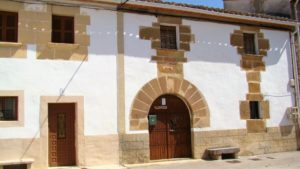
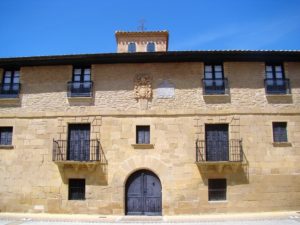 After climbing the Alto de Perdón past Pamplona, the pilgrim sees the vast Valdizarbe below them. Like pearls on a necklace, the towns of Uterga, Legarda, Muruzábal and Óbanos stretch forward in the distance to Puente la Reina, the stopping point of Stage 4. Strong, solid houses are typical of the Navarran style as you pass through these villages. Stone foundations make the base of the ground floor level. These large stones also frame the arched doorways and cornices at the edge of the building. The second floor can be brick or rendered. The upper floor displays small windows tucked up under the eaves. Red-tiled roofs with wooden eaves complete the structure. There is a definite symmetry to the facade with center arched doorways and neatly arranged second floor windows (often with wrought iron balconies). Then topped by small cutouts on the third floor. The colors are earthy tans, browns and rust shades in keeping with the landscape. They present a prosperous appearance, reflecting the comparative wealth of this part of the camino.

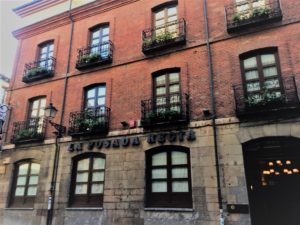 It’s not necessarily shared rooms on the Camino every night. A little luxury can be a great tonic. The Posadas del Camino was created in 2007 for the purpose of bringing together, under a common seal of quality, the most prestigious and best-rated Hotels, Inns and other types of accommodation along the Camino Francés. They offer a welcome place to lay your head after a long day on the road in varied places like Carrion de los Condes or O Cebreiro, Galicia. As well, these country inns and city hotels strive to promote the history, art, nature and rich cuisine of their own region. Just an added touch of comfort. Think of it as one more opportunity to “Experience The Way”. After visiting its magnificent Gothic cathedral, you could relax in the casco antiguo (old town) in Léon at member hotel La Posada Regia.


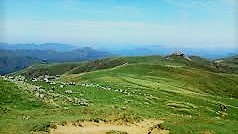
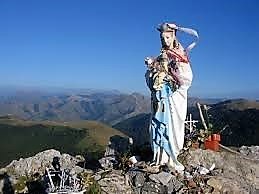 They say that your hardest day on the Camino will be your first. Climbing the Pyrenees towards Roncesvalles from Saint-Jean-Pied-du-Port will test your endurance right out of the gate. If you take the Route de Napoléon straight over the top, you will pass the Virgén de Biakorri at the Pic d’Orisson. Perched on a rocky outcrop and backed by a magnificent view over the surrounding mountains, she acts as protectress of the shepherds herding their flocks through these pastures. You will see this image of Mary and the infant Jesus countless times along your Camino. If by necessity (weather) or desire, taking the lower route through Valcarlos will bring you, after a short step climb, to the Puerto Ibañeta. Here stands the monument to Roland (monumento de Roldán). This stone commemorates an ancient battle where Roland fell fighting the Saracen army before Charlemagne could arrive. This was in the year 778 A.D. One more reminder that your passage is but one more in a long line of travellers.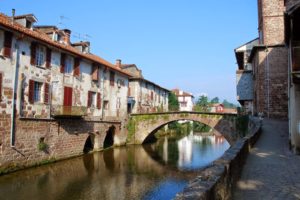
 A journey of 800 km. begins with the first step. Crossing the Pilgrim’s bridge over the River Nive at Saint-Jean-Pied-du-Port to begin the climb over the Pyrenees and start the Camino de Santiago. There will be a lot of uphill and then a lot of downhill crossing over the Pyrenees. Don’t rush it, the knees and feet have to last another 775 km.
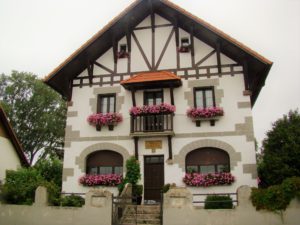 Like all the other sights along the Camino Francés, the housing styles reflect the history, geography and climate the pilgrim will encounter along the route. The climate of northern Spain can run from the searing heat of the meseta to the misty lands of Galicia (known locally as España verde or green Spain). Building materials reveal what was available in the immediate neighbourhood. The lack of stone meant mud-brick adobe in the meseta of Castile-Léon, the abundance of stone in Galicia was the foundation of the traditional palloza (an ancient stone round house with thatched roof). The houses of the Basque country in the Pyrenees were built to withstand the cold winter winds and snow while the buildings in the great plain were designed to hide their occupants from the heat of the midday sun. Some styles are simple in their embrace of the unadorned, massive stone lintels and cornices (in the Navarran countryside) or extravagantly painted in ice cream colours and filigreed ironwork balconies like those of Léon. And wherever you go along the Camino, the beauty of the summer flower boxes spilling over the balcony edge are a delight to the eye. In future posts we will take a look at those houses and what they say about the places in which they were erected and the people who call them home.