

 Not every representation of the pilgrim’s passage is formed in the round. Sometimes, that which we remove makes what is left more visible. On the camino path, as you leave Frómista heading towards Carrion de los Condes, this iconic rendition of the pilgrim silhouette stands out clearly against the blue Spanish sky. It stands guard over the rush of traffic on the Autovia Meseta below. All the elements of your camino are here – the staff for walking, the gourd for water, the flowing cloak, the stars and the scallop shell. An elegant exhortation to continue your journey forward.


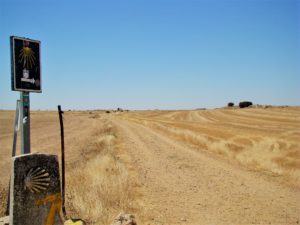

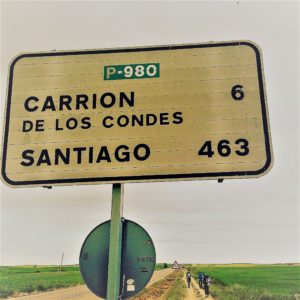 The little yellow arrow is always there pointing the way forward. But it never answers the question – are we there yet?? Pilgrims need not worry. Distance markers are a constant presence along the camino, placed to remind you that there are still many miles to go before you sleep (apologies to Robert Frost). You begin in Roncesvalles, where the sign tells you only 790 km. left, pass the plaque in Sahagún announcing your arrival at the center of the Camino (400 km. left to go) and finally, if you venture further, to the final stone marker in Finisterre (0.00 km). These signposts are strangely comforting… they assure the pilgrim that they are making progress, the wandering is not aimless. And when all those kilometers are finished, you can start dreaming about the day when you return to the camino and begin your own personal journey again.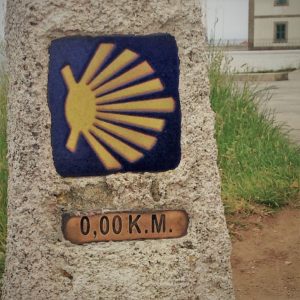
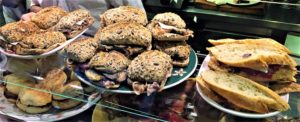
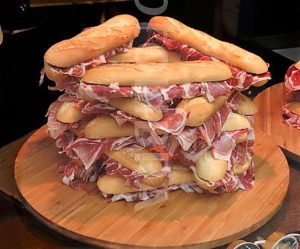 Walking for 20 km. through the Spanish countryside can build a healthy appetite. But, stopping for a real sit-down lunch is not always desirable or practical. Luckily, there is a ready-made solution to the problem of what to eat while trekking along the camino…. sandwiches Spanish-style! A “bocadillo” is a favorite transportable meal usually consisting of a 6-8in. “barra” (baguette), sliced lengthwise down the middle. These are often stuffed with a choice of either ham, cold cuts (embutidos), chorizo, cheese, or tuna. Don’t look to see lettuce, mustard, or mayo here. Maybe, a little rubbed tomato on the cut bread. No other meal has fueled as many pilgrim kilometers as the breakfast bocadillo jammed with “tortilla“, the national omelet of potatoes, eggs and onions. Whichever way you prefer to have it, this portable meal will be one of your best camino friends.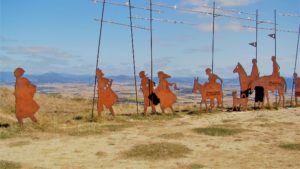
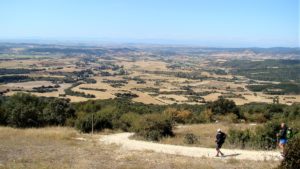 After departing Pamplona, you walk through suburban towns and villages before entering the Navarran countryside. Always in front of you is the heights of the Alto de Perdon, crowned with 21st century windmills. A long, steady climb brings you to the top with its magnificent 360° views. It is here that one of the most famous symbols of the Camino is found. Erected in 1996, the steel figures of pilgrims on foot and horseback were the vision of artist Vincent Galbete. On one of the steeds is the inscription “donde se cruza el camino del viento con el de las estrellas“. (where the path of the wind crosses the path of the stars). After reading such a romantic thought, it’s time to begin the steep journey downward to Puente la Reina.
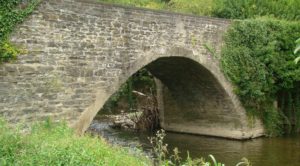
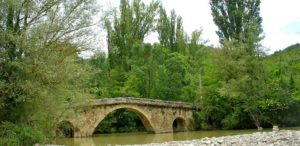
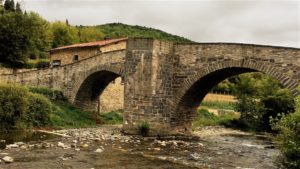 After Roncesvalles, the pilgrim walks through the lower Navarre valleys at the foothills of the Pyrenees. Of the many rivers that flow out of the mountains, the Río Arga will continue along your camino path past Pamplona and through to Puente la Reina before continuing on to meet the mighty Río Ebro as it journeys to the Mediterranean. It is in Zubiri (stopping point stage 2) that the river is spanned by a medieval bridge dating from the 12th century. According to the legend, any animal who passed under the arches of the bridge or around the central pillar would be protected (or cured) of rabies. Today, it is known as the “Puente de la Rabia” (bridge of rabies). While it may not cure any disease, it is a great tonic to stop and refresh your feet in the gentle waters that flow beneath the arches.