
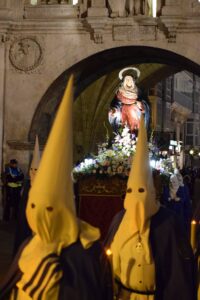
Burgos
Holy Week turns the towns along the Camino de Santiago into something that stops you mid-stride. If you happen to walk the route in the days leading up to Easter, you’ll find the usual rhythm of the road interrupted in the best possible way.
In cities like Burgos, León, and Santiago de Compostela itself, processions take over the streets most evenings from Palm Sunday through Good Friday. These aren’t tourist spectacles — they’re organized by local brotherhoods, some of which have been running the same routes for centuries. Members walk in long robes and pointed hoods, carrying elaborate floats called pasos that depict scenes from the Passion. The floats are heavy — some weigh several tons — and they’re carried on the shoulders of teams working in tight shifts. The physical effort is visible and deliberate.
The processions move slowly, accompanied by drums and brass bands playing music that sounds nothing like a celebration. It’s somber, repetitive, and surprisingly loud in narrow stone streets at midnight. If you’re standing in a doorway watching one pass by lantern light, it’s hard not to feel the weight of the occasion.
For pilgrims on the Camino, Semana Santa adds a layer of meaning to an already loaded journey. The route is explicitly a pilgrimage, and the holy week timing makes that dimension impossible to ignore. Churches that are usually quieter fill up. Towns that sleep early stay awake.
Practically speaking, some businesses close during Holy Thursday and Good Friday, so it’s worth carrying extra food and water. Accommodation in larger cities books out well in advance. But if you can arrange it, walking during this week puts you in the middle of something old and genuinely alive.
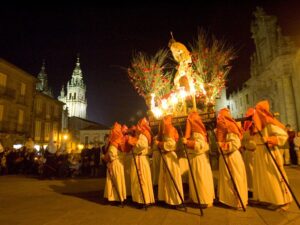
Santiago de Compostela
Holy Week turns the towns along the Camino de Santiago into something that stops you mid-stride. If you happen to walk the route in the days leading up to Easter, you’ll find the usual rhythm of the road interrupted in the best possible way.
In cities like Burgos, León, and Santiago de Compostela itself, processions take over the streets most evenings from Palm Sunday through Good Friday. These aren’t tourist spectacles — they’re organized by local brotherhoods, some of which have been running the same routes for centuries. Members walk in long robes and pointed hoods, carrying elaborate floats called pasos that depict scenes from the Passion. The floats are heavy — some weigh several tons — and they’re carried on the shoulders of teams working in tight shifts. The physical effort is visible and deliberate.
The processions move slowly, accompanied by drums and brass bands playing music that sounds nothing like a celebration. It’s somber, repetitive, and surprisingly loud in narrow stone streets at midnight. If you’re standing in a doorway watching one pass by lantern light, it’s hard not to feel the weight of the occasion.
For pilgrims on the Camino, Semana Santa adds a layer of meaning to an already loaded journey. The route is explicitly a pilgrimage, and the holy week timing makes that dimension impossible to ignore. Churches that are usually quieter fill up. Towns that sleep early stay awake.
Practically speaking, some businesses close during Holy Thursday and Good Friday, so it’s worth carrying extra food and water. Accommodation in larger cities books out well in advance. But if you can arrange it, walking during this week puts you in the middle of something old and genuinely alive.