
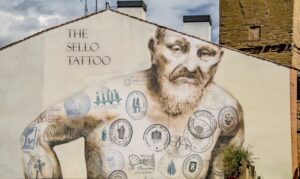
The Camino de Santiago spans over 1,200 years of living history, and while it remains deeply rooted in its Romanesque and Gothic heritage, it continues to evolve as a dynamic and contemporary cultural space. Alongside the centuries of memories carried by countless pilgrims, modern artistic expressions have found a natural home here, engaging in a vibrant dialogue with the present day.
Street art has become one of the most visible examples of this creative energy. In recent years, bold and large-scale murals have brought colour and life to the towns and villages lining every Jacobean route. From modest pieces featuring religious themes and uplifting phrases — such as those found in Rabé de las Calzadas, near Burgos — to entire building facades transformed by powerful imagery and striking monumental figures, these works invite passers-by to pause and reflect.
Artistic installations can be found in both large towns and smaller villages throughout the Camino, and in several locations this creative scene has grown into a significant draw for visitors, adding a new dimension to the pilgrimage experience.
What has emerged along the Camino goes beyond conventional street art — it might better be described as Jacobean muralism: a distinct creative movement whose works draw directly from the spirit, history, and traditions of the pilgrimage route itself.
These murals are far more than painted walls. They serve as a visual expression of the living culture that has grown up around this ancient path over the course of a thousand years. Some pieces retell the legendary stories tied to the Camino, while others explore themes of spirituality or pay tribute to figures of significance connected to the route. Taken together, they form an ever-evolving open-air gallery that reflects both the individuality of each artist and the remarkable diversity of the people who walk the Camino every year.