
 Pamplona is the first major city the pilgrim reaches after de
 scending from the Pyrenees. It is also the largest city along the Camino Francés and the historic capital of the ancient kingdom of Navarra. Over 90% of the wine production of Navarra is red. The main grape variety is tempranillo, but other types such as garnacha and cabernet sauvignon are prominent. Among the whites are chardonnay, malvasia and viura.
After passing over the Alto de Perdon, you enter the first of the sub-regions of wine making, the Valdizarbe, where the main centre of production is Puente La Reina, the stopping point of Stage 4. In addition, you can see the vineyards as you pass through the villages of Legarda and Muruzábal approaching Puente la Reina.
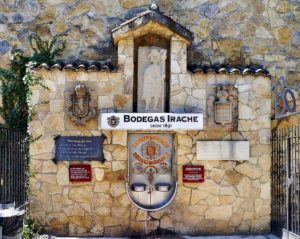
Continuing your journey westward along the Camino brings you to Estella, the stopping point for Stage 5. This is the centre of the next sub-region in Navarra, Tierra Estella. The main grapes you will see are mostly the red tempranillo and cabernet sauvignon. You will pass among the vineyards walking through the villages of Mañeru, Cirauqui, Villatuerta and into Estella. As you make your way to Los Arcos (stopping point Stage 6) you will see the vines in Ayegui, Irache, Villamayor de Monjardín, and Luquin. The long flat road out of Los Arcos passes through Sansol and Torres del Río before reaching Viana and the end of the D.O. Navarra. Remember to fill your cup at the free wine fountain of Bodegas Irache outside of Estella.
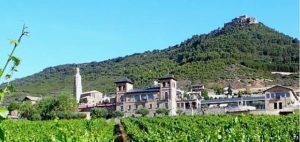
Top photo – Castillo Monjardín winery in Villamayor de Monjardín (stage 6 towards Los Arcos)
Bottom photo – Free wine fountain at Bodegas Irache (outside Estella stage 6)
Next.. Txakoli, the effervescent (and hard to pronounce) white wine of the Basque country.